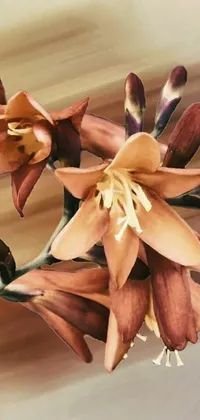
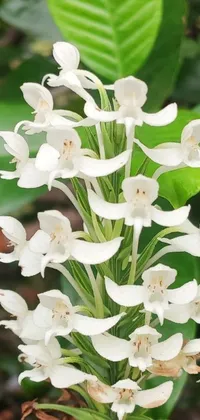
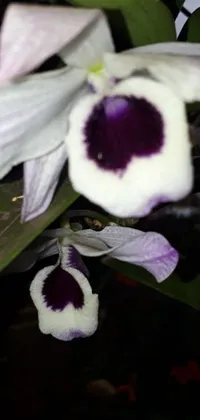
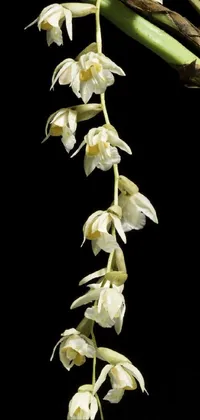
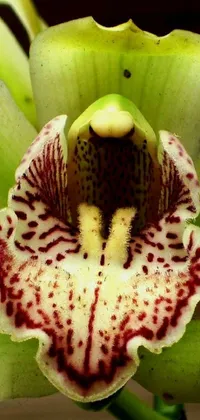
Dendrobium canaliculatum by Ross Harvey, 27 February 2003. This species has a wide variety of plant sizes with pseudo-bulbs from as small as  marbles to elongated styles up to 150mm in length. It is mainly a plant of tropical  Queensland (found also in tropical NT and WA) from Rockhampton in the south to  the tip of Cape York. It grows almost exclusively on paperbark trees hence the  common name of Tea-Tree Orchid. It is found in humid swampy lowland locations  and occasionally in harsh low humidity locations (especially during the winter  months) some distances inland from the coast. It is extremely intolerant of cold, wet  conditions and requires a heated orchid-house in cold locations. The flowering within  the species is extremely variable bearing from 2 - 4 flowers per raceme in the smaller  plants to 40+ flowers per raceme in the larger plants with colour of flowers varying  from white, cream, pale green, yellow and brown with purple or red labellums. The  areas in which they grow have two seasons, wet and dry (and dry meaning no rain for  two to three months with minimum temperatures seldom below 10 degrees Celsius   for long periods). Knowing the natural conditions under which these plants grow is  beneficial in their cultivation.  I am a firm believer in that if you get the environment right you are 70% there in  growing the plant, culture counts for 30%. The environment has three aspects,  Location or Growing House, Light and Ventilation.  Location or Growing House I grow the plants in a shade house covered with opaque  solarweave with walls of glass louvres in the top half combined with fixed glass in  the lower half. This enables me to keep the plants dry in the winter and, by closing  the louvres in mid-afternoon, slightly warmer. I believe that the plants will tolerate  the cold (that we get in SE Qld) and tolerate the wet but not a combined cold and wet.  (Continued) Dendrobium bracteosum  Dendrobium canaliculatum Dendrobium hodgkinsonii Dendrobium ruckeri Dendrobium williamsonii Dimerandra buenaventurae Eria albidotomentosa Eria lobata Galeandra dives Hoffmannseggella fournieri Isabelia pulchella More Articles