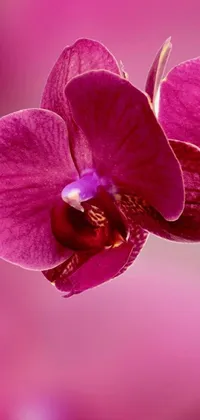
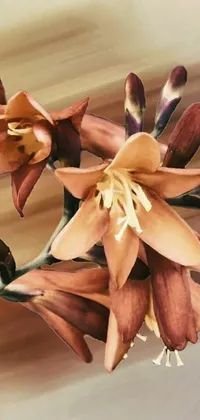
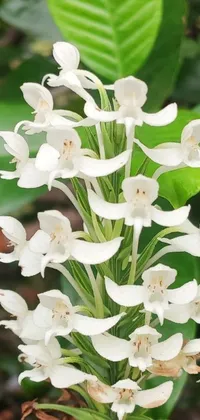
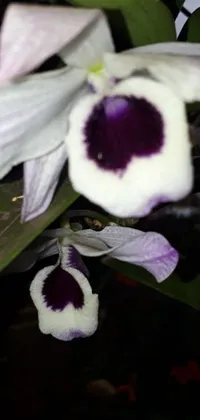
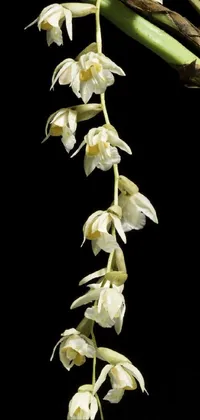
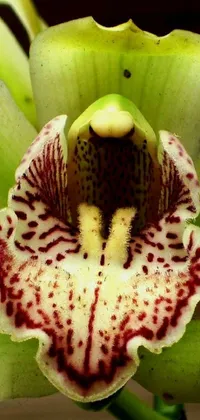
Dendrobium ruckeri Lindl. By Phil Diamond The species occurs in Northeastern India, including Sikkim, Bhutan and the Khasi  Hills, at altitudes of 1300-1700m. It is placed in Section Dendrobium. The plant habit  is pendulous, with long, slender and smooth canes. Flowers occur from the uppermost  nodes of leafless stems, 1-2 per inflorescence and are 3-4cm across. The fragrant  blossoms are primrose. The flowering seen at the October meeting had been staked  upright to display the flowers. The species is often labelled under its synonym D.  ramosum [1, 2]. For the cooler five months of the year, rainfall is low and virtually nonexistent in  May-July (Southern Hemisphere equivalent). Winter temperatures are said to average  4-7 degrees Celsius  minimum, 16-19 degrees maximum and rising to Summer  extremes of perhaps 30. Summer rainfall peaks at around 30 cm/month in Dec-Jan and humidity is around  85%. Despite the dry rest period, humidity is relatively high at around 70% and a  sharp diurnal variation with cool nights suggest that heavy dews supply some  moisture. This suggests that cultivated plants should be allowed to dry out between  winter waterings, but perhaps occasionally misted to prevent dehydration. In nature,  the rest period is that of maximum light intensity [1]. My plant was bought at one of  the Spring shows this year and was (still is) overpotted in sphagnum. After flowering,  weather permitting, it will be grown fairly dry until new growth commences, when it  will be repotted in a smaller pot with peat & perlite, normal watering resumed, and  hung high up in a tall citrus tree. Watering will be greatly reduced, as new growth  matures, in late March-April.  References [1] M.L. Baker and C.O. Baker, \Orchid Species Culture: Dendrobium", Timber Press, Portland, Oregon, 1996. [2] B. Lavarack, W. Harris and G. Stocker, �Dendrobium and its Relatives", Kangaroo Press, Sydney, 2000. Dendrobium bracteosum  Dendrobium canaliculatum Dendrobium hodgkinsonii Dendrobium ruckeri Dendrobium williamsonii Dimerandra buenaventurae Eria albidotomentosa Eria lobata Galeandra dives Hoffmannseggella fournieri Isabelia pulchella More Articles