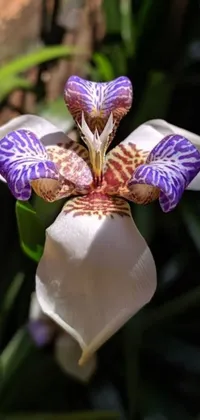
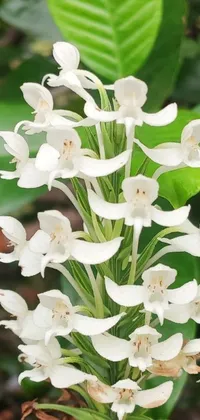
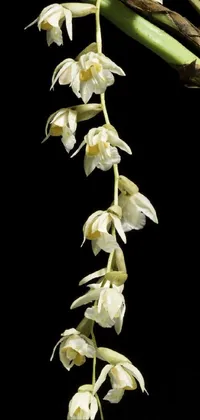
Eria lobataby Bruce & Chris BennettWe purchased our plant 6 years ago from Orchids by Olympia (Robert Friend) as E.floribunda. Gary has since advised that it is in fact E.lobata. We have absolutelynothing on this species and cannot find any previous reference to it. So until Garyreturns it is a case of the blind leading the blind.Our plant has been potted in Perlite/Peat, currently the super coarse mix, in a 200mmpot hanging relatively high under 50% shade plus the white polycarbonate roof of theshade house. It is a large plant of 4 x approx. 400mm stems which are completelycovered by the leaf bracts, and are from 25mm thick at the base to 15mm at the apex.There are 14 leaves arranged in pairs on the stem, with a distinct mark near their basejoining the leaf bracts. The leaves drop of at this position leaving the bracts whichthen turn brown but remain wrapped around the stem which is never actually visible.Flowers appear at the apex of stems on 4 or 5 separate inflorescence in a tight bunchwhich extends with age, the bottom flowers drop after a few days and more openabove. Each flower has a large, 25x5mm, white bract tipped with a green point, thisbract remains after the flower drops. The small flowers,10-12mm, are single on a10mm pedicel, sepals and petals white, the column edged both sides in purple, thelabellum is complex, double lobed each side, generally white with green down themiddle, and purple on each side lobe. Quite a beautiful and shapely flower (on a 10power glass), one which you would never pick on Greg & Gary’s “What Orchid isThat” at our Xmas party.Dendrobium bracteosumDendrobium canaliculatumDendrobium hodgkinsoniiDendrobium ruckeriDendrobium williamsonii Dimerandra buenaventuraeEria albidotomentosa Eria lobataGaleandra dives Hoffmannseggella fournieri Isabelia pulchellaMore Articles